
Cold seeps through the soles of my shoes, making the space between the bones of my feet ache, working its way up into my ankles. We’d picked this spot in the spring. The plot beneath the lilacs. There had been a pair of cardinals in the branches. “This spot,” Fran said. “It feels like home.”
A touch on my elbow. I turn my head. Elise. No, the younger daughter, the architect. Donna. She’s so grown up. “How are you doing, Dad?” she asks. It’s a ridiculous question. We stand in silence. The last leaves on the alder rattle in the bitter wind, refusing to let go. “It looks like it’s going to snow,” she says as she links her arm through mine. Her feet shuffle as though to warm the ground.
I look up at the sky to keep a cold tear from falling. “It’s Fran’s favourite colour, you know?”
“What is?”
That cold, white, steel-grey blue of a November sky. She called it November blue. “Blue,” I say.
“I never knew that.”
We watch the sky in silence.
“We should join the others,” Donna suggests. They want to start.” She tugs my elbow as she turns. “It’s too cold to be out here long.”
Start what? I almost say the words, then turn and see our grown children and grandchildren gathered around the stone that we picked out together. Steel grey flecked with black. Our names and years—birth and death, as though these are the most important, as though nothing of significance happened in between—etched on the front, a blank space for my year of death. “TOGETHER FOREVER” and clasped hands. But we’re not together, are we? My daughter tugs my elbow, and my frozen feet stumble. I’m sure I’d told them to engrave my year of death the same as hers. We were going to die together.
I often lie in bed, deep in the night, almost awake, remembering. What school did I go to? What was the first airplane I soloed in? What was my Canadian Airlines employee ID? How did Fran wear her hair that first day I met her, walking through Heathrow Airport? Where did we take our first holiday? Who is important in my life? The answers flow easily: Claremont High; De Havilland Chipmunk; 67357; shoulder-length with ends curled up and out in that beautiful, natural, sun-kissed shade of blonde that eventually faded to silver (she never once dyed her hair in forty years); Barbados for three luxurious days, after which I knew I’d do anything, sacrifice anything to be with her forever; my two daughters and Fran’s children, all of our grandchildren—six, no, eight—but mostly Fran, always Fran, forever Fran. And I would move my foot to her, lying beside me sleeping, to feel her warmth. And I would listen to her soft breath.
But recent memories are harder. What day was yesterday? Maybe a Tuesday? It doesn’t matter, really, except that I go for coffee with my grandson on Mondays, and I don’t remember if I did that yesterday.
But then there was that unforgettable Tuesday.
“I was thinking about Tuesday,” Fran said one morning. She was lying on her side in bed, breathing deeply, almost rasping. I thought I’d heard her being sick in the night, but maybe it was a dream.
“Tuesday?”
“I’m going to talk to the doctor, to my kids about dying on Tuesday.”
“Don’t talk like that. We haven’t tried everything. Maybe they can do more radiation—shrink it or stop it from growing so fast.”
“We’ve talked about this. You asked the doctor about this last week and the week before. There’s nothing.”
“What about Mexico? We could try that treatment in Mexico. That article you read.” Why was she giving up without a fight? We were going to die together.
Together forever. A joint ceremony, a shared urn, one plot. But now, apparently, we lived in a world where one can schedule death.
“That Mexico article is almost fifteen years old. That was the first tumour. You’re getting now mixed up with then.” She’d said it gently, tears in her eyes, her cold hand on my bad shoulder. She was always cold towards the end.
I try, but can’t recall the rest of the conversation. How many days did we have until Tuesday?
And then it was Tuesday.
She laid out my clothes. “These are for the funeral.” I must have tried to stop her, but Fran was like that. Practical, get things done. I would have given anything to stop time, to just hold her. “David will stay the night tonight. He has everything in hand with the funeral home.” I’m sure I told her that I didn’t need him to stay. Only her. I needed her to stay.
“Your daughters will be here by the weekend. They’ll take you for another tour of the home. There’s a suite available in January. They’ll be here to help you until then. I’ve written everything on the calendar in the kitchen.”
“I don’t need them. Just you.” We sat on the end of the bed for a long time that Tuesday morning, my arms around her. She was so brave. I, the coward, couldn’t let her go.
“I’m tired. I need to lie down.” How long had we sat there on the bed?
Suddenly the house was full. Her kids and the grandkids. Fran trying to drink more water, not throw up, so the vein would take the needle. The day had gone too fast and suddenly the doctor was there, and I held Fran in my arms on the faded sofa. She was so thin, just brittle bones clinging to a tumour. She made a joke, but I couldn’t laugh. “I’ll see you soon,” she murmured, her eyes on mine. She was the same beautiful young woman I’d seen in Heathrow—her smile, her blue eyes—a lifetime ago. And then she was limp and heavy in my arms, and people with a stretcher took her away.
When I woke the next morning, I prayed it was only a dream.
If I roll over and she’s there, it was only a dream, I told myself. But she wasn’t there.
If I move my foot over to her side and it’s warm, then it was only a dream. But the bed was cold.
If I get up and there are no cars in the driveway, then it was only a dream. But there was a black car in the driveway, her son David’s. He slept over so I wouldn’t be alone. What would have been so bad about leaving me alone? But it’s what she’d wanted.
I decided to slip in the shower or fall off the roof. Then I’d forgotten. I have to keep reminding myself—tonight, I’ll do it tonight.
“Come over here, Daddy. Stand here. We’re going to start.” A blonde woman with a toothy smile puts her arm around me. Elise. The older one. The daughter who’s always organizing, planning, pushing and pulling. Her face is red and wet, despite her forced smile. She must be cold.
I shrug to lose her arm, but it only gets tighter, heavier.
One of the grandsons is playing guitar and singing. We must have gone to a hundred of his musicals over the years. Fran remembered every one, every character he’d played. I flex my gloveless fingers, wonder how he can play in this cold. His voice catches, stops. “Sorry,” he says and starts again.
A man with oily black hair and a rough overcoat holds a green velvet bag over a hole in the ground. I can almost feel Fran leaning into my shoulder, joking that he looks like an undertaker, and laughing her great big belly laugh. But he is the undertaker, and inside that bag is Fran in the wooden urn she picked out. My matching urn—the one I insisted I didn’t need—is on our bedroom dresser. It should be both our ashes in a single urn. We said we’d always be together, then the tumour came back, looking to finish her this time.
The man slowly lowers the bag into the hole, but I step forward to grab his arm. “You have to take her out of that bag.” How will we become one with a polyester bag around her? That was the reason for the wooden box, something that would break down, nothing left between us, to keep us apart.
“I’m sorry, sir, but it’s regulation,” he explains. He drops Fran and straightens up. His coat is cold and rough in my fist.
“Take her out of the bag,” I repeat.
Elise is pulling me away. Always pushing and pulling, this one. “It’s okay, Daddy. It’s the law. He can’t bury a wooden box without the bag.” She speaks slowly and too loud, then jostles me back into this huddled semi-circle.
“Ridiculous,” I mumble. But it’s okay, I’ll come back tomorrow when this is all over with and do it myself. Maybe crash the car afterwards on the way back home.
Each person takes a flower from a bouquet being passed around and then steps forward and drops it into the hole, onto Fran. Now the oily-haired man is holding up a spade. “If anyone wants to . . .” he says, gesturing.
I want to ask, wants to what, when David takes it and flicks a bit of dirt into the hole. He plants the tip on the frozen ground and hunches over the top of its handle. He slowly shakes his bowed head and chokes, “Goodbye, Mum.” He’s gasping for breath, the shovel the only thing keeping him upright.
I step forward, nudge his elbow and begin to fill in the hole. There’s not enough dirt. I scrape the last of the soil into the hole, then tamp it down. A flurry of hands try to wrestle the shovel away from me. I’ll be back tomorrow, I remind myself. I mustn’t forget to come back and release Fran from the bag.
The undertaker snatches the spade, and Elise herds us back into a civilized huddle. “Take as long as you need,” he says, shuffling his feet as though to remind us that he’s cold and it’s time to go home.
Seconds later everyone is wandering off towards their cars.
The cold is coming up from the ground through my shoes. I should be wearing winter boots in weather like this, not these silly loafers—my going-out shoes. But Fran had laid out my clothes, and this is what she thought I should wear today.
I turn my eyes to the wide sky. A snowflake lands on my cheek, stays for a moment and melts. Small flakes drift out of the November blue sky. It’s Fran’s favourite colour. I find her watch in my pocket, notice it’s past noon. She’ll be wondering where we are. Lunch is always exactly at noon.
My daughters are here, one on each side of me, Elise and Donna. They’re so grown up.
“Ready?” Donna asks.
Elise takes my arm.
“We should be getting back. Fran will be waiting with lunch,” I say, setting my gaze back on the sky.
“Oh, Daddy,” Elise says, her voice stuttered and strained, as she pulls me over the frozen grass.
Donna’s voice is soft, dreamy. “I wonder what she’s made. Hopefully soup.”
Yes, hopefully soup. She makes great tomato soup.
Cheryl MacLean
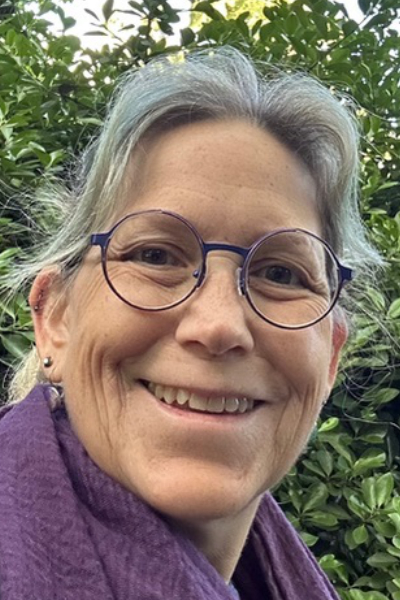 Cheryl MacLean is a Canadian AWA (Amherst Writers and Artists) workshop facilitator and owner of Casa Mismac writing retreat in Costa Rica. Her fiction and creative nonfiction has appeared in Peregrine Journal and elsewhere online and in anthologies. She splits her life between Canada and Costa Rica and when in neither location, she’s probably snuggled up with her laptop or notebook at a writing retreat.
