It has nothing to do with the fact that I dried. Or maybe it has everything to do with it
A number of people came up afterwards, trying to reassure me with some variation of “a bad rehearsal means a good show.” Clara, our stage manager, said it twice. It wasn’t even a full dress, more like a line run after our unexpected break, with a few tech cues. But if Lear can’t remember his lines, is there even a play?
That was yesterday.
Now I’m caked in make-up, making my already wrinkled and sagging face ludicrously aged. I’m robed in fake furs and desperate enough to gnaw my own leg off to escape this terror. This is unlike any stage fright I’ve known before.
As the five-minute call comes over the loudspeaker, I crawl behind the couch in my dressing room and hide like I’m five years old.
The dusty couch smells of ancient sex.
*****
There are stories about the madness that descend on actors during a long run. But when I dried, it wasn’t because I was playing a grieving son and saw my actual father appear as a ghost on stage. Nor did I hallucinate Shakespeare himself, scribbling in a smoky tavern the very words I was speaking, as some national treasure once claimed. Those actors were both playing Hamlet anyway. That play conjures madness.
What does Lear conjure? A preoccupation with age and regret? Check. A drawing up of accounts? Check. And sure, a dash of madness too. The old-fashioned, theatrical kind. Not something you’d ever find in the DSM. And not, as some have claimed, a doorway into senility.
The spotlight obscured the darkened auditorium. I squinted out from the stage at an endless, snowy plain. Something like the long stretch between Stratford to Toronto in January, but without any fences, roads, billboards, or power lines. Just a lifeless landscape of white and shadow, beneath a smothering mauve-grey sky. A bitter wind. A sharp desolation. The entire play vanished.
*****
If I don’t run now, I will die.
*****
Gloucester pokes his head in my dressing room but misses me behind the couch. I wait until there are fewer voices passing outside the door. The corridor empties. Actors are taking their places. For a little while, I follow my daughters, Goneril and Regan, before ducking down another corridor to the exit. Actors and crew often congregate just outside the door in a haze of vape smoke. I cross fingers on both hands that no one is here and nod to the Old Impresario, the resident ghost, a remnant from the theatre’s vaudeville days floating near the fire extinguisher.
My robe is regal and solemn and not created with a real Ontario winter in mind. The cold slaps my cheeks red. I should have left the robe behind for Paul, my understudy, and grabbed my coat. And some gloves. A hat would have been good too.
I’m reversing out of the parking space when the theatre door is thrown open. Poor Clara, clutching her clipboard, swearing into her headset, gesticulating madly. I’m sorry, I mouth, but she can’t see. I’m already too far away.
*****
My phone rings as I reach the on-ramp for the highway. I stare at the device, tinkling on the passenger seat, in surprise. I must have grabbed it alongside my keys on the way out. It’s worrying what I’m capable of forgetting these days.
“Ben?”
Elena has that surface calm in her voice, barely betrayed by the worry beneath. A consummate actress, my wife. If only she had taken to the stage. “Ben, where are you? Clara said you left. What is it? Are you sick?”
“I’m not—shit.” The car yanks to the right as it hits a patch of black ice. At the same time a large transport truck roars past. Its air horn blares like some dying dinosaur.
I hate driving in winter.
“Where are you?” A barely perceptible tremor breaks through her calm. I never expected that. Not my implacable, unflappable wife. “Whatever it is, it’s okay. You can come home. The play will be fine. Paul’s gone on in your place. Everyone will understand.”
“I’m not sure I understand.”
“It was too soon to go back to work. After Leon and everything.”
I check the rear-view mirror, check my speed, the fuel gauge, the odometer.
“He was a year younger than me.”
“I know. I’m sorry.”
“No, you don’t. You’re sixteen years too young to know.” My hands tighten around the steering wheel, as if I could squeeze my rage into her. “You think I wake up sore every day because I don’t stretch enough. You think if only I went to the doctor, my arthritis could be cured. I’m seventy-two, not fifty-six. You can’t possibly understand.”
Another truck comes up from behind, drowning out her response.
Younger wives don’t know what they’re signing up for. They’re still reaching for their prime when we begin to shrivel. And all parties end up dismayed by what’s happening. Too many miles on the odometer. There’s no cure for that.
“I’ll be home in a couple of hours,” I say.
*****
There had been no performances scheduled for Sunday, Monday, Tuesday, or Wednesday. So yesterday, the day after the funeral, was the first time I entered the theatre since that disastrous night. The first time I passed through the hall where the paramedics had parked the stretcher as they assessed the scene. The first time I stood in the wings after my director, my oldest friend, collapsed at the top of the second act. The paramedics had loaded the body into the ambulance, told Clara which hospital they were taking him to, and driven off with speed and sirens. I wasn’t fooled. I had seen his face.
I turned to the Old Impresario, hovering near the props table, and said, “Leon is dead.”
He gave a ghostly shrug and melted away. No help from that corner.
And then we started rehearsal. No wonder I dried.
*****
The turn-off for Stratford—and Elena—sails by. I glance at my reflection in the rear-view mirror, vaguely surprised by the wild man I see. I had grown out my white hair and beard for this role, thinking to look more king-like. And of course, only when it was artfully dishevelled for the storm scene, could I then look like a mad, ranting, Old Testament prophet. Leon had pitched this production as a post-apocalyptic Game of Thrones. Medieval fantasy, he said. I certainly never anticipated such sadness gazing back.
I’m not ready to go home.
I have spent my career keeping my voice strong, my body limber for the stage. Acting requires a certain stamina, and I don’t know any other way of being. I don’t know what else this creaking old body is for.
God, I am tired. I could sleep for a thousand years.
*****
“Actors are hollow men,” Leon pronounced. He was already deep in his cups when Elena and I arrived after the show. She had brought me flowers. No one had ever brought me flowers after a show.
“Only men?” Elena said. Not an actor herself, but keen on precision in language. Heaven help me, I had fallen for an academic.
“And women. Actors are hollow men and women,” he amended. “We’re like The Wicker Man.”
“You’re drunk,” I said, irritated. I wished I were drunk too, but this was still in the early days of dating Elena when I was trying to impress her. Before we met, the drinking was starting to become a problem. Abstaining made nights at the bar after a show a lonelier experience though.
“All theatre is ritual,” he proclaimed. “The most ancient of rituals. Most people don’t want to plumb the depths of their souls, to examine their lusts and greed and fears. They definitely don’t want to do these things alone. So they pay us to do it for them, to act out their stories. They commune in the dark while we bare their souls.”
I was half-listening, much more interested in snaking my hand around Elena’s waist, in pulling her close, in smelling her hair.
“And we call it art. Or craft. Or whatever. We’re only stand-ins—scapegoats. We go to these dark places on their behalf.”
Leon struggled off his stool to stand. He clutched at my shoulder, partly for balance and partly to keep my attention. I had to release Elena to hold him upright. His pinching grip was relentless.
“So when it’s our turn, Ben, when it’s our turn, we can’t do it. Not genuinely. Not without a degree of self-awareness. It’s all performance. Falling in love. Dying. Everything. Always. It’s show. We’ve sacrificed our own souls—for them.” He gestured round the emptying bar. Elena was gathering our coats, looking at me meaningfully.
“So maybe stop acting,” I said, hardly disguising my impatience. “Maybe try directing instead.”
*****
It took a few years, but he did become a director. One of the best. And then he became my director. I trusted him completely.
*****
“. . . ‘tis our fast intent / To shake all cares and business from our age, / Conferring them on younger strengths while we / Unburdened crawl toward death.” Act one, scene one. The speech that really starts the engine of the play going. Lear intends to divide up his kingdom among his daughters, but in a final show of dominance, demands expressions of their love to determine the size of their share. But it’s all a lie. Crawling toward death. Please. He’s a king. He’s never crawled toward anything. He doesn’t for one second believe he’s really going to die.
Neither did I, until now.
*****
I’m going to miss it all. The other actors. Elena calls them my tribe. The crew. The heat of the lights. The smell of sweat and make-up and spirit gum. The expectant hush as the lights go down. The up-rushing thrill of applause when they go up again. Even the throat-clearers and the coughers who come night after night. I love them all. This must be why the Old Impresario sticks around. He can’t bear to leave.
I can’t keep driving forever. There’s no sign, at least none that I see, to tell me where I am. But I turn off from the clamour of the highway anyway. I relax a little.
Something, some quality of the night’s stillness or its silence lures me out of the car. A line of trees at the far end of the field wave at me with their lacy black branches. It isn’t quite my vision from earlier. The sky had been clouded over then. Now I wade through the stretch of unmarred snow under a monstrous number of stars—the Milky Way. Nothing between my balding pate and the universe.
My feet sink deeply into the soft snow. I have to step carefully because there’s no grip on these shoes, and they want to slide in every direction. My ankles are immediately wet. They burn with cold. I stumble, unburdened, into the empty field. Its dreamy peace seeps into me. For once, my stupid thoughts have stopped racing.
The sound of an approaching car causes me to turn and frown at the interrupted quiet. It comes to a stop behind mine. A figure emerges, calls out something indecipherable from this distance, waves frantically. She races through the snow, obliterating my wandering prints. Anger, irritation, relief, and love tumble over each other as she crashes into me. I wrap my arms around her simply to keep from falling over.
Elena holds my face close to hers. Her hands are icy cold, but her breath warms my face.
“You old fool! Maybe you should try directing instead.”
Jennifer Falkner
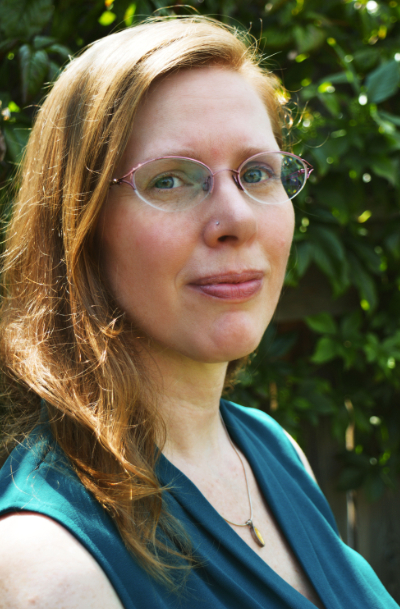 Jennifer Falkner (she/her) is a short story writer living in Ottawa, Canada, on the unceded territory of the Algonquin Anishinaabe First Nation. She is the author of Susanna Hall: Her Book (Ottawa Book Award finalist) and the short story collection Above Discovery. www.jenniferfalkner.ca